Power track vs socket comes down to one question: will your appliances stay where they are, or move? A wall socket gives you power at one fixed point. A power track gives you a rail where sockets can be added, moved and removed along its length. This guide compares the two on flexibility, load, safety, cost and installation, using figures from our own product specifications.

A wall socket is a fixed outlet that stays where the electrician put it. A power track is a rail with adaptors that clip on and slide along it, so you place a socket wherever an appliance sits. Choose a socket for appliances that stay in one place, and a track for counters, desks and consoles where your setup changes.
A wall socket, often called a normal socket or general power outlet (GPO), is wired into one position during the renovation. Each faceplate serves the plugs at that spot, so an appliance further along the counter needs a longer cable or an extension block; our article on power tracks, power strips and power rails compares those options. Moving a socket later means calling an electrician to rewire it.
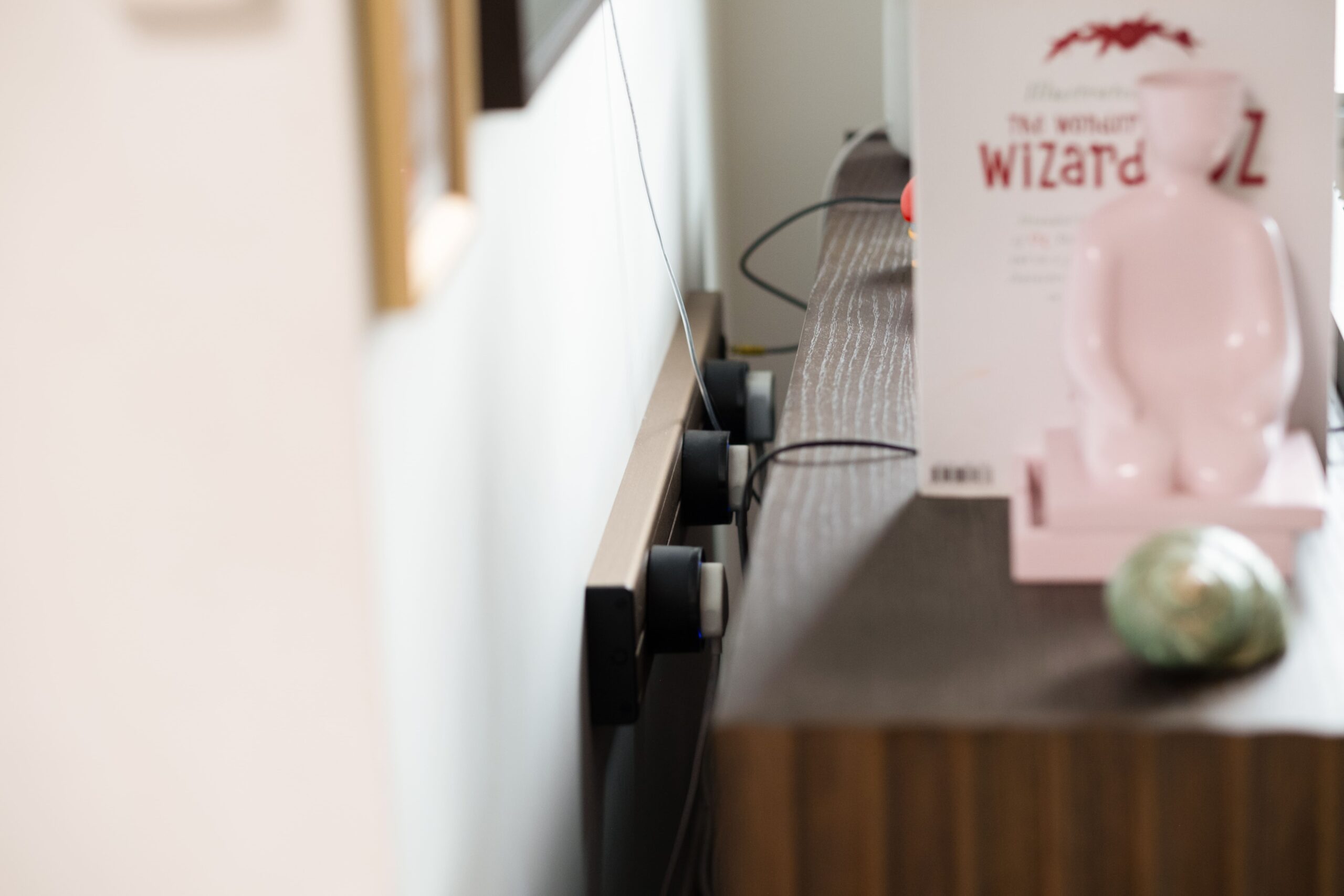
The track carries power along its whole length, and each socket is an adaptor that clips into a groove and twists to lock. Each of our UK adaptors is rated at 13A and takes one appliance. One metre of our track supports up to 11 adaptors, and the total power draw of everything plugged in should stay within 8,000 watts.
Our guide to how a power track works explains each part in more detail.
The first difference in power track vs socket is position: a socket stays at one point, while an adaptor moves to wherever you need it on the track. The second is the number of outlets: a socket offers what its faceplate holds, while a track takes as many adaptors as its length allows.
The third is change over time. Moving a socket needs rewiring, while moving an adaptor takes a twist by hand. The last is the look: sockets sit at fixed points on the wall, while a track runs as one clean line along a wall, counter or cabinet.
A wall socket suits appliances that stay in one place for years, such as a fridge, a washing machine or a wall-mounted heater. It also suits rooms where you only need power at one or two points. In these spots, the power track vs socket choice favours the socket.
A track earns its place where appliances change position with the task. On a kitchen counter, the kettle, the coffee machine and the rice cooker can each sit where you use them; our kitchen power track guide covers placement and load for a busy counter. Along a study desk, a track gives a socket for each charger and monitor, and behind a television console it keeps the screen, the speakers and the router on one neat line.
Both are safe when installed by a qualified electrician and used within their ratings. In Singapore, the Safety Mark must be affixed on controlled goods that have been tested and certified to the relevant safety standards. Our registration numbers are 220001-00 for the tracks and 220002-00 for the adaptors, and our tracks are certified to BS 5733, the British standard for general electrical accessories. Our adaptor locks to the rail when it is switched on, and it stays locked in place until it is turned back to the off position.
A wall socket is part of the renovation wiring. Our tracks start from S$147 for a 50cm SLIM Series length in a standard colour, and our power track price guide shows how the track, the adaptors and the installation add up. Installation is generally S$60 per point, and the exact figure is confirmed after a free site survey. Our electrician then makes the connection at the end terminal.
For many homes, the answer to power track vs socket is both: wall sockets serve fixed appliances, and a track serves the places where the setup changes. Our power track range shows every series and finish, and our page on power tracks in Singapore sets them side by side. Book a complimentary consultation at our design showroom near Kallang, and bring photos of the wall or counter you have in mind.

Yes. A recessed track sits flush in a cut-out, which your carpenter prepares from the dimensions we provide. Our SLIM recessed track needs a cut-out 71mm wide and 25mm deep, and a surface track mounts straight onto the wall.
Our standard colours include Royal White, Midnight Black and Grey. Our Pro track can also be finished in surface laminates to match your carpentry, which takes 7 to 10 working days to prepare.
Our Pro track runs up to 3 metres in one length, which covers most counters, desks and consoles. For any other length, contact us directly and our consultants will advise on the best layout for your space.
Yes. Our electrician connects the track to your home wiring once, at the end terminal. After that, you add, move or remove adaptors along the rail by hand whenever your appliances or layout change.
Click on the link to find out more about our services and products. Chat with our sales representatives today!
WhatsApp Us
Home
About Nexen
Our Products
Luxe Collection
Power E-Bar Collection
Kinetic Switch