A kettle, a toaster, a rice cooker, an air fryer, a blender: small kitchen appliances make daily cooking easier, and they need a plan to stay that way. This guide shows how to organise kitchen appliances and the rest of your kitchen equipment: where each one belongs, how to group them by task, and how to bring power to the places you use them. The power figures come from our own product specifications.

Arrange small kitchen appliances by how often you use them and what task they serve. Keep daily appliances on the counter in the zone where you use them, store occasional ones in lower cabinets, group the morning appliances into one breakfast station, and plan sockets or a power track along the counter to match.
Before moving anything, watch how you move. In a Singapore HDB flat or condominium kitchen, as in most kitchens, cooking happens between three points: the sink, the stove and the fridge. Designers call the path between them the work triangle, and the appliances you reach for most should sit along it, within a step or two of where you use them.
Then list the small kitchen appliances you use every day, every week and only a few times a year. That list decides almost every placement that follows.
Dividing the kitchen into five zones keeps related things together: a prep zone, a cooking zone, a cleaning zone, a storage zone and a serving zone. The blender and food processor belong in the prep zone beside the chopping board, the air fryer and rice cooker in the cooking zone near the stove, and the kettle near the sink for easy filling.
When every appliance has a zone, you spend less time crossing the kitchen and more time cooking.
Counter space is the most valuable space in a kitchen, so give it to the appliances you use every day. A kettle, a toaster and a coffee machine earn their place on the counter. A slow cooker, a stand mixer or a bread maker that comes out once a week fits better in a lower cabinet, where heavy items are easy to lift out.
Lighter items you use occasionally, such as a hand mixer or a spare kettle, can go on a higher shelf.
Group the kettle, the toaster and the coffee machine into one breakfast station, with mugs, bread and coffee in the cabinet above. Your morning routine then happens in one spot, and the rest of the counter stays clear for cooking. Our article on where to put a kettle and toaster looks at this corner in more detail.
Shelves and hooks above the counter hold light items and keep them within reach. Inside cabinets, pull-out shelves and lazy Susans bring items at the back to the front, and drawer dividers keep utensils, cables and small tools in their own places. Labels on shelves and containers help everyone in the home put things back where they belong.
For the surface itself, our guide to organising a kitchen countertop covers what to keep out and what to store.
An appliance can only sit where it can be plugged in, so plan the power with the layout. Our article on where to put electric sockets in a kitchen explains how to match socket positions to each zone.
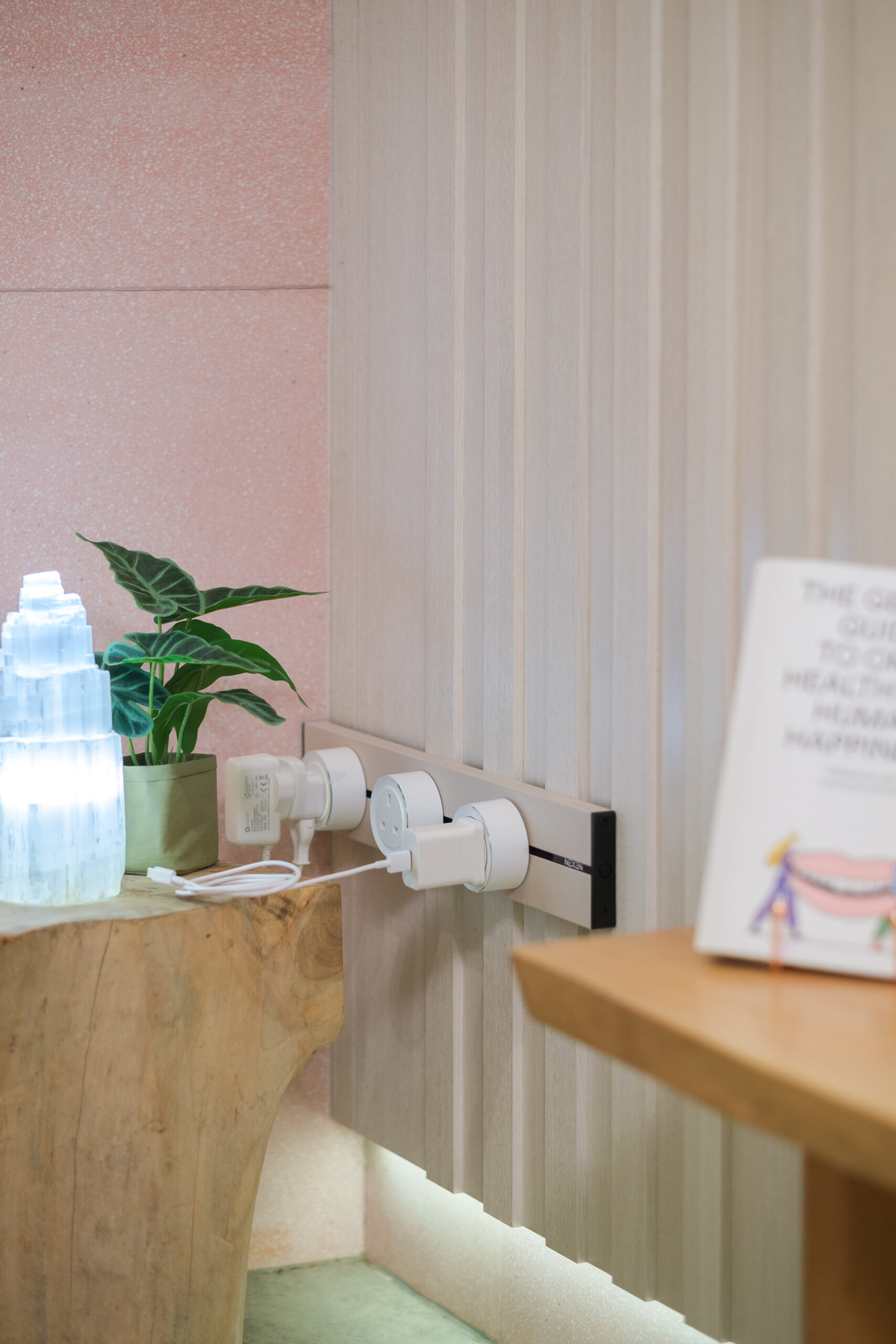
A power track along the backsplash lets you place a socket wherever an appliance sits, and move it when the layout changes. Each of our UK adaptors is rated at 13A, and the total power draw of every appliance on one track should stay within 8,000 watts. Add up the wattage on the rating labels of the kettle, the air fryer and the microwave before you decide how many tracks you need. Check for the Safety Mark on any adaptor you buy; ours are registered under 220002-00.
Our kitchen power track guide covers placement, load and cost for the whole counter.
Good light makes every zone easier to use. Under-cabinet lighting brightens the counter below wall cabinets, where most prep work happens, and makes appliances easy to see and reach in the evening.
A kitchen changes as appliances come and go. Every few months, look at what has stayed on the counter and ask whether you still use it every day. Move it to a cabinet if you use it less often, and give the space to the appliance that has earned it.
If you are planning a renovation or rearranging a kitchen you already have, our power track range can bring a socket to every appliance on the counter, and our page on power tracks in Singapore shows the series side by side. Book a complimentary consultation at your home or at our design showroom, and bring a list of the small kitchen appliances you use every day.

Our SLIM Series comes in 50cm, 75cm, 100cm and 150cm lengths, and our Pro Series in 60cm, 80cm, 100cm and 150cm. Measure the stretch of counter where your appliances sit, then choose the length that covers it.
Store them in a lower cabinet or a tall pantry cabinet close to the zone where you use them. Keep their cables wound and tied, so each appliance comes out ready to plug in when you need it.
A surface track mounts on the wall or backsplash and suits a finished kitchen. A recessed track sits flush in a cut-out, which your carpenter prepares during a renovation. Our SLIM and Pro series each come in both styles.
Place the microwave at a height you can see into, close to the cooking zone and away from the sink. A shelf or a tall cabinet above the counter frees space below, as long as a socket or power track sits nearby.
Click on the link to find out more about our services and products. Chat with our sales representatives today!
WhatsApp Us
Home
About Nexen
Our Products
Luxe Collection
Power E-Bar Collection
Kinetic Switch